

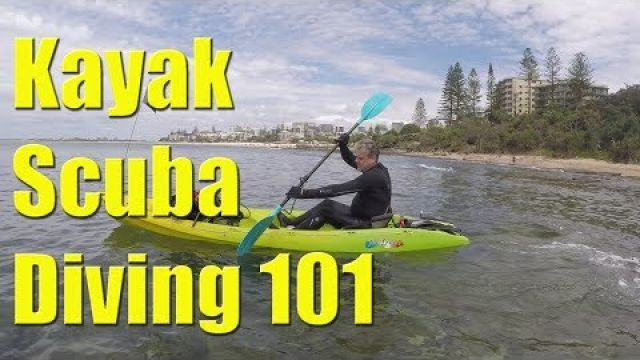
In this video I take you through how to kayak dive 101. I offer tips tricks and suggestions which you can adapt to suit your needs and your kayak design and ...
Closed Captions (CC):
Hey people of the interwebs it is Q and
this time we're not going on a scuba
diving adventure, we're going on a kayak
diving adventure. In this video I'm gonna
show you what you need to go kayak
diving, how you load your kayak up and
also how to get your gear off the kayak
when you get to your dive spot and how
to get your gear back into the kayak
after you've finished diving.
Obviously there are a couple of
essential items you're going to need, the
first thing is a kayak. I personally use
a two seater kayak, I sit in the back and
paddle and steer and have my dive gear
secured into the front seat section.
The second most important thing you're gonna need is a car with a roof rack, so
thatyou can transport your kayak from home to whichever dive site you're going to.
You may also need the assistance of a friend to help you put the kayak onto the roof.
But with my setup I actually have my
kayak slung from the rafters of my
garage and a pulley system set up that I
put together using an old boat trailer
winch, so I can quite easily put the
kayak onto the car and take it off again
single-handedly. Obviously once the kayak
is on the roof rack you need to secure
it with some straps. I use a rhino rack
and it came with its own straps and
these straps I really like, because the
metal buckle is actually encased or
surrounded by a very thick rubber so
when you're throwing the straps over the
kayak from one side of the car to the
other, the metal buckle is not going to
bang into one of your car windows and
potentially break it.
These nice rubberized ones just bounce. Whatever you do don't take any half measures,
make sure you put two straps on and make sure everything is neat and tidy and very
firmly secured. Here you can see the
metal buckle and the rubber that
surrounds it. Make sure it's really firm
and these particular straps also come
with this great little velcro tie-down,
which you can use to secure the loose
ends so they don't flap around in the
wind when you're driving along.
When you're happy the kayak is secured and you've got everything else loaded into
the back of the car you can quite
happily drive off to your dive destination.
if you're following the usual scuba diving rules you will of course
be diving with a buddy, so once
you do get to the dive spot you can help
each other and get the kayaks off the
car and take them straight down to the
water line.It's much easier to carry an
unladen kayak to the water line than it
is to load it up at the car and then try
and struggle with all that weight
getting it to the water line. Attached to
the side of the kayak, to the right of the
seat, you can see a black bag and in there is my kayak anchor which is also attached
to a short length of chain and then I've got 50 meters of rope in there as well.
Next comes the fun part, which is getting
all your gear from the back of the car
and to the kayak and making sure
everything is firmly secured into place.
I have a set sequential way that I do
this every time and that way I'm never
gonna miss something. I start off with my
flag, my paddle and my integrated weight
pouches. Normally when you go diving you
would have one of the divers carrying a
dive flag which floats along with you on
the surface, but when you are kayak
diving all you need is for each kayak to
be equipped with a dive flag so that other watercraft can see there are divers
down below and if they know what the
rules are they have to stay at least 50
meters away from the dive flag. The
golden rule of kayak diving is to make
sure that every piece of equipment is
firmly attached to the kayak and I mean
absolutely everything. You might think
you're the bee's knees at kayaking but
once you've got all that dive gear and
the extra weight in there, things really
change if you've got some waves on the
surface and it's quite easy for one of
these things to roll over and if they do
roll over and you haven't got something
secured you're going to lose it and you
don't want to lose expensive dive
equipment. The straps I use are made out
of a bungee type material, but mine
are getting a little bit long in the
tooth now and should be replaced shortly.
I make sure that those are out of the
way before I place my tank and BC and
regs into the front seating area and I
always place my tank so that the valve
is closest to me. Next I pop my
integrated weights into place. Now if you
don't use integrated weight pouches and
you're still using a dive weight belt
then you would put that around your
waist once you've loaded all your gear,
you're in your wetsuit and you are ready
to set off.
So with the BCD and tank in place, we
take our bungee cords and pass them
through the d-rings of the BCD and then
attach them firmly to the kayak. At this
point you can turn on your air because
you're going to need to inflate your BCD
so that it firmly locks it into place
underneath the bungee cords. Next I bring
my mask and snorkel and fins and I'm
pretty lucky in the design of this kayak,
in that I have this handy little well,
that's just behind where I sit and it's
also got these buckles so I can securely
fasten those things into place and
they're not going to go anywhere.
Obviously things won't be the same with
a different design kayak and you'll have
to improvise as best as you can,
but the prime objective is to make sure
that everything is firmly and safely
tied down.
Just before setting off I always stow
the paddle with one end underneath the
BCD. A final check before we set off to
make sure that we've got everything we
need and everything is secured, because
you don't want to be paddling out fifty
or hundred or two hundred meters and then get to the dive spot and find you've
forgotten something. When you do reach
your dive spot the first thing is to
drop anchor and make sure you get a good
solid connection with something down
below, then stow your paddle and swing
your legs over the side. Then I reach
around behind the seat and the first
thing I want to do is put my mask on,
remembering of course that you will be
out in the open ocean so there will be
waves to contend with. The reason we
put our mask and fins on first is
because if we do happen to fall
overboard or get knocked overboard then
we are able to see and also maneuver
ourselves in the water. With those items
equipped it's a quick bum shuffle up to
the front end of the kayak and now you
can see why I have the tank valve facing
towards the seat, because if I need to
switch the air on or off I can quite
easily reach it. Unhook the bungee cords
from one of the anchor points on the
kayak and pass them back through the
d-rings on the BCD.
Grab hold of the bungee cord that's
attached to the kayak on the side that
your legs are dangling over and secure
the loose end to the d-ring on the BCD,
this will act as a tether for when you
throw the BCD and the tank overboard,
because if there's any current on the
surface your BCD will be long gone by
the time you've got yourself in the
water and you're chasing after it. Always
tether your BCD to the kayak and always
remember to fully inflate the BCD before
you throw it overboard.
Once the BCD is in the water it's time
to throw yourself in after it. Now it's
time to cast your mind back to the hazy
memory of your open water course, because
if you were taught correctly, one of the
things you should have learned was how
to remove and replace your equipment on
the surface. There are various methods of
doing this and it doesn't have to be
textbook, it just has to be comfortable
and easy. But what I do is open the
buckle, open the cummerbund, make sure all
the hoses are out of the way and put one
arm in first, followed by the second arm.
With that done, do up the cummerbund, do
up all your buckles and tighten your
shoulder straps. You may find it a little
bit awkward or difficult at first,
especially if there's some current on
the surface or waves, but practice really
does make perfect. Once you've got
everything set up just right it's time
to untether from the kayak and drop
below the surface. What we usually do is
gather at the anchor line and head down
as a group, because one of the things
that you want to do when you hit the
deck is to just ensure that your anchor
is firmly attached at the bottom. You
want that kayak to be exactly where you
left it when you finish your dive. A
really useful dive course to have if you
are kayak diving is navigation because
you're gonna use the anchor point as your
fixed point and you're going to swim
around and navigate back to that fixed
point at the end of the dive. One of the
other pieces of equipment that I'm going
to be purchasing shortly for kayak
diving, is a very powerful strobe which
I'll attach to the anchor line around
about 3 or 4 metres above the anchor.
So assuming you've had a great dive and
you've managed to navigate your way back
to your kayak, once you hit the surface
it's pretty much a reverse procedure,
with a couple of little additions. Once
you've fully inflated your BCD, the first
thing to do is to tether yourself back to
the kayak by attaching the bungee cord
to the d-ring on your BCD. The second
step is to get rid of that lead weight.
Now I use integrated weight pouches, so I
pop those out individually and
immediately put them inside the hull of
the kayak. If you're using a weight belt
it's the same procedure, immediately put
it inside the hull of the kayak and
secure that hatch. Now it's back to your
open water training course where you
remove your gear on the surface and
because your BCD is tethered to the
kayak you can quite happily just leave
it be while you're attempting to get
yourself back into the kayak. I generally
come from the opposite side to which the
BCD and tank are tethered because it
will act as a counterbalancing weight,
however in this video example I can't do
that. Launch yourself up onto your belly,
with your belly button around about the
midsection of the kayak and then just
roll over and you'll be sitting in the
right position. Now as you remove each
piece of gear remember it has to be
tethered, don't leave it for a second,
because if some freak wave comes and
knocks you over or rolls the kayak
you're going to lose that expensive dive
equipment. Again I have a sequence that I
follow, so the mask and snorkel comes off
first, followed by my fins.
At this point you can quite happily
leave your paddle floating on the
surface of the water because it is
tethered to the kayak and it gives you
more room to maneuver. Another quick bum shuffle up to the front end and you're
ready to bring your BC and tank back on
board. Do up the cummerbund, make sure
all your hoses are safely and securely
inside and do up the buckle.. Now because
we removed our integrated weight pouches
there's a lot less weight that we have
to drag on board. Again it's all about
practice and technique and I use my foot
to give myself some extra leverage to
get the BC and tank on board. Once it's
back into position,
grab the other bungee cord and pass it
through the d-ring of the BCD and
securely attach it to the kayak.
Again fully inflate the BCD for the same
reasons we did it the first time around.
A final bum shuffle back into the seat,
retrieve your anchor, grab your paddle
and head for home.
If you found this video helpful and
you'd like to see some more, please
subscribe to the YouTube channel. If you
have any comments or questions about
this video or suggestions for other
videos I can do, please leave them in the
comments section, as soon as I see those
I'll get back to you. Thanks for watching
and take it easy.
Closed Captions (CC):
Hey people of the interwebs it is Q and
this time we're not going on a scuba
diving adventure, we're going on a kayak
diving adventure. In this video I'm gonna
show you what you need to go kayak
diving, how you load your kayak up and
also how to get your gear off the kayak
when you get to your dive spot and how
to get your gear back into the kayak
after you've finished diving.
Obviously there are a couple of
essential items you're going to need, the
first thing is a kayak. I personally use
a two seater kayak, I sit in the back and
paddle and steer and have my dive gear
secured into the front seat section.
The second most important thing you're gonna need is a car with a roof rack, so
thatyou can transport your kayak from home to whichever dive site you're going to.
You may also need the assistance of a friend to help you put the kayak onto the roof.
But with my setup I actually have my
kayak slung from the rafters of my
garage and a pulley system set up that I
put together using an old boat trailer
winch, so I can quite easily put the
kayak onto the car and take it off again
single-handedly. Obviously once the kayak
is on the roof rack you need to secure
it with some straps. I use a rhino rack
and it came with its own straps and
these straps I really like, because the
metal buckle is actually encased or
surrounded by a very thick rubber so
when you're throwing the straps over the
kayak from one side of the car to the
other, the metal buckle is not going to
bang into one of your car windows and
potentially break it.
These nice rubberized ones just bounce. Whatever you do don't take any half measures,
make sure you put two straps on and make sure everything is neat and tidy and very
firmly secured. Here you can see the
metal buckle and the rubber that
surrounds it. Make sure it's really firm
and these particular straps also come
with this great little velcro tie-down,
which you can use to secure the loose
ends so they don't flap around in the
wind when you're driving along.
When you're happy the kayak is secured and you've got everything else loaded into
the back of the car you can quite
happily drive off to your dive destination.
if you're following the usual scuba diving rules you will of course
be diving with a buddy, so once
you do get to the dive spot you can help
each other and get the kayaks off the
car and take them straight down to the
water line.It's much easier to carry an
unladen kayak to the water line than it
is to load it up at the car and then try
and struggle with all that weight
getting it to the water line. Attached to
the side of the kayak, to the right of the
seat, you can see a black bag and in there is my kayak anchor which is also attached
to a short length of chain and then I've got 50 meters of rope in there as well.
Next comes the fun part, which is getting
all your gear from the back of the car
and to the kayak and making sure
everything is firmly secured into place.
I have a set sequential way that I do
this every time and that way I'm never
gonna miss something. I start off with my
flag, my paddle and my integrated weight
pouches. Normally when you go diving you
would have one of the divers carrying a
dive flag which floats along with you on
the surface, but when you are kayak
diving all you need is for each kayak to
be equipped with a dive flag so that other watercraft can see there are divers
down below and if they know what the
rules are they have to stay at least 50
meters away from the dive flag. The
golden rule of kayak diving is to make
sure that every piece of equipment is
firmly attached to the kayak and I mean
absolutely everything. You might think
you're the bee's knees at kayaking but
once you've got all that dive gear and
the extra weight in there, things really
change if you've got some waves on the
surface and it's quite easy for one of
these things to roll over and if they do
roll over and you haven't got something
secured you're going to lose it and you
don't want to lose expensive dive
equipment. The straps I use are made out
of a bungee type material, but mine
are getting a little bit long in the
tooth now and should be replaced shortly.
I make sure that those are out of the
way before I place my tank and BC and
regs into the front seating area and I
always place my tank so that the valve
is closest to me. Next I pop my
integrated weights into place. Now if you
don't use integrated weight pouches and
you're still using a dive weight belt
then you would put that around your
waist once you've loaded all your gear,
you're in your wetsuit and you are ready
to set off.
So with the BCD and tank in place, we
take our bungee cords and pass them
through the d-rings of the BCD and then
attach them firmly to the kayak. At this
point you can turn on your air because
you're going to need to inflate your BCD
so that it firmly locks it into place
underneath the bungee cords. Next I bring
my mask and snorkel and fins and I'm
pretty lucky in the design of this kayak,
in that I have this handy little well,
that's just behind where I sit and it's
also got these buckles so I can securely
fasten those things into place and
they're not going to go anywhere.
Obviously things won't be the same with
a different design kayak and you'll have
to improvise as best as you can,
but the prime objective is to make sure
that everything is firmly and safely
tied down.
Just before setting off I always stow
the paddle with one end underneath the
BCD. A final check before we set off to
make sure that we've got everything we
need and everything is secured, because
you don't want to be paddling out fifty
or hundred or two hundred meters and then get to the dive spot and find you've
forgotten something. When you do reach
your dive spot the first thing is to
drop anchor and make sure you get a good
solid connection with something down
below, then stow your paddle and swing
your legs over the side. Then I reach
around behind the seat and the first
thing I want to do is put my mask on,
remembering of course that you will be
out in the open ocean so there will be
waves to contend with. The reason we
put our mask and fins on first is
because if we do happen to fall
overboard or get knocked overboard then
we are able to see and also maneuver
ourselves in the water. With those items
equipped it's a quick bum shuffle up to
the front end of the kayak and now you
can see why I have the tank valve facing
towards the seat, because if I need to
switch the air on or off I can quite
easily reach it. Unhook the bungee cords
from one of the anchor points on the
kayak and pass them back through the
d-rings on the BCD.
Grab hold of the bungee cord that's
attached to the kayak on the side that
your legs are dangling over and secure
the loose end to the d-ring on the BCD,
this will act as a tether for when you
throw the BCD and the tank overboard,
because if there's any current on the
surface your BCD will be long gone by
the time you've got yourself in the
water and you're chasing after it. Always
tether your BCD to the kayak and always
remember to fully inflate the BCD before
you throw it overboard.
Once the BCD is in the water it's time
to throw yourself in after it. Now it's
time to cast your mind back to the hazy
memory of your open water course, because
if you were taught correctly, one of the
things you should have learned was how
to remove and replace your equipment on
the surface. There are various methods of
doing this and it doesn't have to be
textbook, it just has to be comfortable
and easy. But what I do is open the
buckle, open the cummerbund, make sure all
the hoses are out of the way and put one
arm in first, followed by the second arm.
With that done, do up the cummerbund, do
up all your buckles and tighten your
shoulder straps. You may find it a little
bit awkward or difficult at first,
especially if there's some current on
the surface or waves, but practice really
does make perfect. Once you've got
everything set up just right it's time
to untether from the kayak and drop
below the surface. What we usually do is
gather at the anchor line and head down
as a group, because one of the things
that you want to do when you hit the
deck is to just ensure that your anchor
is firmly attached at the bottom. You
want that kayak to be exactly where you
left it when you finish your dive. A
really useful dive course to have if you
are kayak diving is navigation because
you're gonna use the anchor point as your
fixed point and you're going to swim
around and navigate back to that fixed
point at the end of the dive. One of the
other pieces of equipment that I'm going
to be purchasing shortly for kayak
diving, is a very powerful strobe which
I'll attach to the anchor line around
about 3 or 4 metres above the anchor.
So assuming you've had a great dive and
you've managed to navigate your way back
to your kayak, once you hit the surface
it's pretty much a reverse procedure,
with a couple of little additions. Once
you've fully inflated your BCD, the first
thing to do is to tether yourself back to
the kayak by attaching the bungee cord
to the d-ring on your BCD. The second
step is to get rid of that lead weight.
Now I use integrated weight pouches, so I
pop those out individually and
immediately put them inside the hull of
the kayak. If you're using a weight belt
it's the same procedure, immediately put
it inside the hull of the kayak and
secure that hatch. Now it's back to your
open water training course where you
remove your gear on the surface and
because your BCD is tethered to the
kayak you can quite happily just leave
it be while you're attempting to get
yourself back into the kayak. I generally
come from the opposite side to which the
BCD and tank are tethered because it
will act as a counterbalancing weight,
however in this video example I can't do
that. Launch yourself up onto your belly,
with your belly button around about the
midsection of the kayak and then just
roll over and you'll be sitting in the
right position. Now as you remove each
piece of gear remember it has to be
tethered, don't leave it for a second,
because if some freak wave comes and
knocks you over or rolls the kayak
you're going to lose that expensive dive
equipment. Again I have a sequence that I
follow, so the mask and snorkel comes off
first, followed by my fins.
At this point you can quite happily
leave your paddle floating on the
surface of the water because it is
tethered to the kayak and it gives you
more room to maneuver. Another quick bum shuffle up to the front end and you're
ready to bring your BC and tank back on
board. Do up the cummerbund, make sure
all your hoses are safely and securely
inside and do up the buckle.. Now because
we removed our integrated weight pouches
there's a lot less weight that we have
to drag on board. Again it's all about
practice and technique and I use my foot
to give myself some extra leverage to
get the BC and tank on board. Once it's
back into position,
grab the other bungee cord and pass it
through the d-ring of the BCD and
securely attach it to the kayak.
Again fully inflate the BCD for the same
reasons we did it the first time around.
A final bum shuffle back into the seat,
retrieve your anchor, grab your paddle
and head for home.
If you found this video helpful and
you'd like to see some more, please
subscribe to the YouTube channel. If you
have any comments or questions about
this video or suggestions for other
videos I can do, please leave them in the
comments section, as soon as I see those
I'll get back to you. Thanks for watching
and take it easy.
Scuba Diving - How To Kayak Dive 101 - Tips Tricks and Suggestions #ScubaDive...
Uploaded by:
Sailing A B Sea
•
Category:
Sailing, General Vlogs
•
Added on
19 May 2018
Description
In this video I take you through how to kayak dive 101. I offer tips tricks and suggestions which you can adapt to suit your needs and your kayak design and...
Closed Captions (CC):
Hey people of the interwebs it is Q and
this time we're not going on a scuba
diving adventure, we're...
Closed Captions (CC):
Hey people of the interwebs it is Q and
this time we're not going on a scuba
diving adventure, we're...