

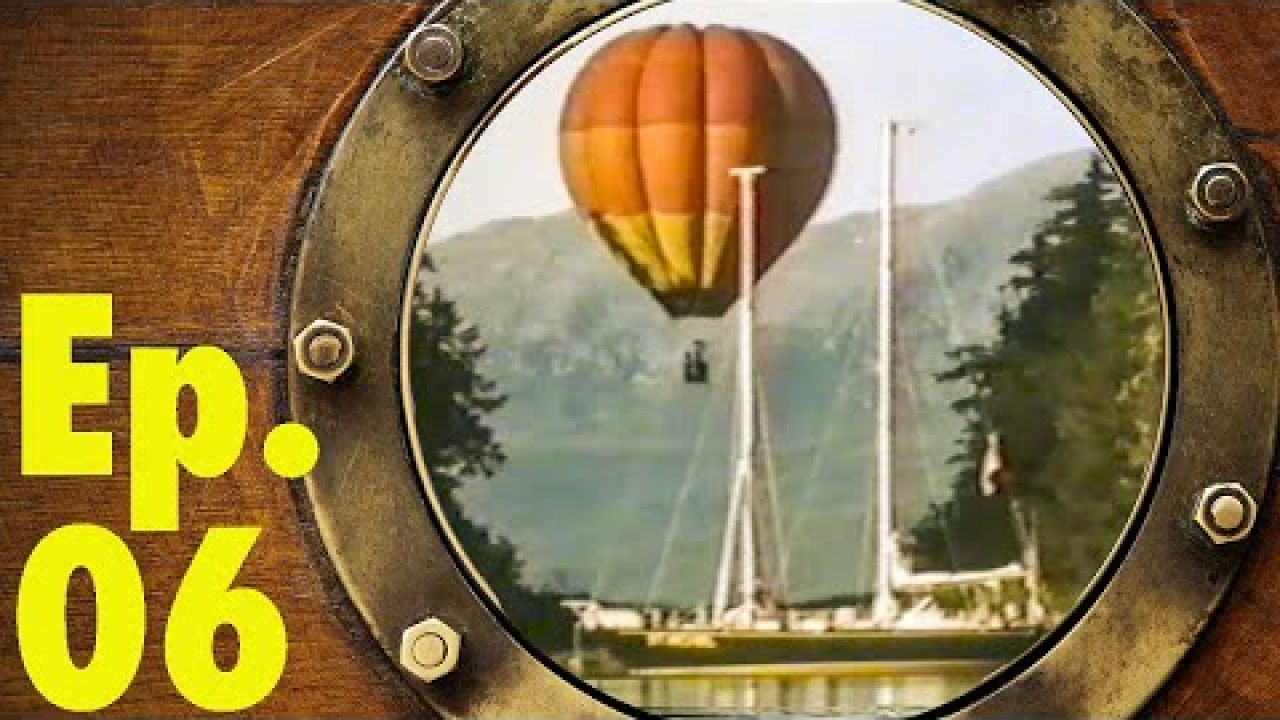
Support Joachim https://paypal.me/vernondeck?locale.x... The Family that Dared is the story of the Campe Family who sold everything they owned, built a boat and set off on an adventure none of them would forget. This might sound all too common but the family did it in 1977! This is the 6th of 12 episodes that Joachim Campe filmed. They were all shot on 16mm film and have not ben seen since airing on German TV in 1984. Joachim, now 83 is very close to finishing another Circumnavigation aboard St Michel, the very same boat that the family sailed on four decades ago. His health has let him down and he is currently recuperating in Lombok, Indonesia and could use your support to get him sailing again. Enjoi! #Alaska #Learningbydoing #sailing If you enjoy my videos and appreciate the effort that goes into making them then perhaps you would be interested in supporting their production. A little goes a long way https://www.patreon.com/vernondeck https://paypal.me/vernondeck?locale.x... A link to a recent podcasts I've done: http://www.visualrevolutionary.com/podcast http://wearelookingsideways.com/podcasts/073-vernon-deck https://www.oceansailingpodcast.com/p... NEW!!! Get your Learning By Doing merch here!!! https://teespring.com/stores/learningbydoing SUBTECH https://www.subtechsports.com Promo code: teamsubtechvernon Discount: 20% off (Free Shipping World wide) Indiana Paddlesurf: https://shop.indiana-sup.ch VERNON10X (10% discount code) Please visit: http://www.vernondeck.com INSTAGRAM: https://instagram.com/Vernondeck/ FACEBOOK: https://goo.gl/WNrSV5
Closed Captions (CC):
Alaska is not on any of the normal circumnavigation routes. We headed for Alaska
although this means a detour of 9000 miles
for us, extending our journey around the world by a year . We sailed from the Galapagos Islands to the Aleutian Islands,
hiked through the volcanic Cutmy area and have now crossed the
Gulf of Alaska, which is notorious for its stormy winds. It's the beginning of September. Southeast Alaska lies ahead of us.
The huge massif of Mount Fairweather rises 4663m above sea level. We are attracted by
the dimensions of this country, the special light conditions of the northern seas, the rich
fauna and the deserted landscape. Behind these mountains in front of us lie the fjords of
Glacier Bay and Frederic Sound. We want to explore this area and use our boat to get to
the edge of the glaciers. Although the coast seems close enough to touch, we still need
two days to reach our first anchorage at the entrance to the fjords.
We are anchored near Elfine Cove, at the entrance of Icey Straight. In this area
dense rainforests collide with glaciers and high mountains. You can only visit this part of
Alaska by boat. Bays and fjords form a system of waterways that penetrate
an area of over 100,000 square kilometers. In spite of the greatest loneliness, we are at home here in our boat.
Early in the morning I use our diesel heater to warm the cabin in advance. I try to be quiet so that
I can stay a little alone while breakfast is being prepared.
In a short time our four children will wake up, Marie will come out of the aft cabin and Christian
our teacher, who has his area of life in the foredeck, will appear. Here in Southeast Alaska
we want to experience four natural phenomena. Nowhere in the world do the mountains rise so directly
over 4000 meters from the sea. We want to sail in front of this mountainous world. We want to follow whales in their
feeding grounds and we want to roam the Eight Tables National Park. We also want to watch
the calving environment glacier at the end of a fjord. We have a month to complete this plan.
Before the fall storms set in, which make any navigation in this area impossible,
we should have reached our winter port of Seattle in the USA. It is our idea to ride in a hot air balloon to
get an overview of the mountains and glacier world. Today we will
meet on land with Jack, a pilot from Seattle who, at our
request, brought his balloon to Elfin Cove in a fishing boat.
Seven of us live on our boat St Michel, which was built for us four years ago in France
and where we also started our journey. We have made the interior of the boat as pleasant as possible
while on deck is spartan simplicity. Here in the cabins
we have to feel comfortable and find the strength to get through our ventures.
Calyxte is seven years old and shares with Sylvestre who is 13 years old a cabin.
Only the main cabin is heated with a diesel stove and there is no
hot water system in the bathroom, getting up at a cabin temperature of twelve degrees Celsius is
quick and easy. Our boat San Michel is 14m long and 4.4m wide. We lived a lot on deck in the
warm climates. In Alaska the furnace is the center of all
activities. Cooking, eating, washing, school, navigation, repair work, writing a diary and playing,
mingle in the same room. Otherwise the boat has become narrow here in the cold regions.
Marie, my wife, she is French, will take a balloon ride today. It will be
the first ever balloon flight in this region. Bartholome and Laetitia 12 and
11 years old live in the opposite cabin. The cabins seemed small to the children
when they moved there three years ago and now they can hardly keep them tidy with all
the collections, shells, bird feathers, stones, coins, stamps and animal teeth that
demand space with exercise books, clothes and handicraft tools.
Christian, the teacher who has been traveling with us for six months, comes out of his cabin next to the bathroom.
Jack our pilot came from Seattle and I could feel his tension.
He checked every little thing
He wanted that nothing unforeseen would happen. We tramp down the grass
so that the balloon has space. I couldn't imagine how big that balloon is,
but during the preparation I saw that Jack the pilot was very careful, so I wasn't afraid for Marie.
I can hardly bear to watch this balloon
fly anymore. It grew and grew and grew so I thought it was really great.
I've actually never seen a balloon, this balloon seems so huge, so huge.
The terrain in southeast Alaska is very dangerous for balloon flights.
In the rugged mountains and in the dense rainforests there are
hardly any opportunities to land a balloon. If the balloon went down in the water
we could only survive for minutes at a water temperature of six degrees Celsius.
We are lucky it is one of the few windless days,
the prerequisite for the ascent with a balloon is in such narrow open spaces.
Marie climbs into the balloon. Because of seasickness and the cold she has been pushed
hard on the limit during the long crossing. I hope that the balloon ride
in an extraordinary environment will be a kind of compensation for the hard work.
Today, a September day i am happy.
We were in Alaska for three months. Alaska was like a fortress to me,
it was so big and so hostile. The mountains, the glaciers,
the rough sea. It was unacceptable. I felt that I didn't have a place here.
I had to really fight first to even have the will to discover the country.
Alaska was very different from what I had imagined. My first difficulty was
coping with the dimensions of this country. If we wanted to sail into a bay it took a
lot longer than we thought, sometimes several days although it looked like a couple of hours.
I'm afraid for the children and us in this vast empty space.
Gradually i got used to it when the landscape passes under me it is as
if i leave myself. I can't believe it's me here
I have to hold on, grab hold of that to feel myself. I don't want to waver.
I want to be sure and keep the experiences of the last few weeks and keep them in me.
Jack our pilot doesn't want to go higher with the balloon. he fears a
change in the weather and would have the greatest difficulty in approaching a
landing site when the wind comes up. We give up our plan to sail across the glacier world from the air
and are already on our way back into the fjord landscape the next day.
I am open to the unexpected. I started our journey
three years ago with this attitude. The approach to these mighty mountains seems to me to be
a challenge but that is exactly what excites me so much.
It was a tough ride and now we are here and it's wonderful to be alive.
A day of sailing can be so beautiful. We are on the sea and only move with the wind,
it is a wonderful feeling but it is not always like that. i enjoy these days and
the sea is simply our natural element and we feel very comfortable here now. It is
a wonderful feeling to sail into the light. To have a shining sea in front of you,
to move silently. Glacier bay has only been freed from the ice of the glaciers in the last 200 years.
The John Hopkins inlet in front of which we sail is considered to be one of the most impressive fjords in the
world because from here you can see Mount Quincy Adams and Mount Fairweather both rising over 4000 meters
straight out of the sea and in front of them the break-off of the John Hopkins Glacier .
During our trip out of Glacier Bay
and into Frederic Sound we encounter the first Humpback Whales.
Whales at the beginning of the trip in Newfoundland were a danger for me.
Now in Alaska in Frederic Sound we have gotten into the rhythm.
Bartholome is fascinated. He dreams of living in a log cabin in in Alaska. He
assures me that his future wife should be able to live with him in solitude.
Sailing in the sheltered waters of south east alaska is particularly beautiful during the summer months in the land of
twilight hours. We can hardly imagine that large fishing boats
here in winter become extremely top heavy due to excessive icing and turn over in a storm. We get used
too little sleep and experience twilight and nights with the moon and stars in great intensity.
We always listen into nature, we never feel cut off from nature.
200 years ago this area, where the rainforest stands today, was covered in glaciers.
The weight of the ice was so great that the land had sunk
by a meter. Today the forested area rises by 34 cm every year, the unevenness of the
ground was left by the glacier when it retreated. Large boulders are
completely overgrown with moss and over vegetation. As the glacier retreated, the land was
conquered by a fixed sequence of plants. Mosses settled first,
then the silver birch came and spreads. The first elders grew and were later overshadowed by willows and
poplars. The poplars have been displaced by the now standing spruce trees and are in turn
threatened by the Hemlock. In 100 years there will only be Hemlock trees here.
The frequent rain and the long incidence of light on summer days create a thicket that
would have been more likely to be in the tropics. The fact that gold diggers worked here
at the beginning of the century is no longer recognizable. Moss and lichen
camouflage and cover the huts that individual adventurers had built here.
I think of the strong,
triumphant life that emerges from this forest. The Eagles soaring so high above all the peaks
and overlooking everything and never taking their eyes off us and all the little
rodents that are so difficult to find and to see.
You see traces of them everywhere. The berries grow and many plants come to life
from this dead one. But I just think of life, the huge area that is
used everywhere to give more life, to gather strength to survive. You feel a lot all at
once, only the stronger impressions remain when I look back and get a picture again.
Sylvestre concentrated because he has a fish or who he paints then
I really notice how important the children are for us that we make this trip together.
When painting, the calm is so pleasant and the nice thing about painting is that the picture gets more and more life.
There can still be so much happening around me and I only think of the sheet that I have in front of
me and how I can best use the colors that I have and how that works best.
After five days we leave our anchorage. At the end of the Entrycode Fjord
is the Doors Glacier, which is currently particularly active.
We want to sail there and watch the ice break off.
Everyone helps with the sailing. We know that the route suggested is risky. It has not
previously been used by a sailing boat. The steep cliffs of the fjords block
the waves of our ukw transmitter so we will be cut off from any help.
We are well equipped for the adventure ahead. Our steel hull is a
prerequisite to face the ice.
We have two engines with two propellers, two
generators, two battery banks and a rubber dinghy on deck.
The landscape that surrounds us is virgin rainforest. The steep cliffs of the
fjord are lifted from the glaciers. Spruce trees have grown in the most unbelievable places.
The landscape seems gloomy and threatening to me and then again alluring and beautiful.
A particularly narrow passage that lies in front of us is called Fords Terror. The geographical
name of this area comes from the gold digging time around 1900 when individual pioneers came out with
canoes. Mr Ford was one of them, he was hit by the vortex shown
at this narrow point and capsized. Although we pass through in a tidal standstill,
I can feel the current, having to navigate carefully because of the individual shallow spots.
I don't always feel good in nature, sometimes beyond the world.
Nature here is so excessive, so powerful. Actually it only inspires fear. The
amount of water that comes down from the mountain, the rockfalls, the size of the forest - everything is
so overwhelming. A person is nothing at all and I feel that I hardly exist.
Maybe you should just let yourself be
overwhelmed but somehow you have an instinct to resist and want to defend yourself
and sometimes I just want to stay in the boat and not even look at it.
To think about it is one thing but to experience it myself is something that really takes me away. I feel it gets on
my soul so quickly and that I am not strong enough to feel it
all for a long time. The children make something out of it and nature is then taken for granted.
For me it is never self-evident, it is always actively destroying something or building something
up to become even more powerful and actually the main impression is fear.
A cold wind blows off the glacier and I revise my schedule.
Before the ebb current sets in, we must have already left this fjord area, as
the tidal currents bring in the ice so tightly that we are cut off on our way back.
We must reach our anchorage before this happens.
The drift ice becomes thicker, collisions with individual icebergs are inevitable, our steel hull
survives the blows. This trip to the Doors Glacier is our last project in Alaska.
Bartholome tries in vain to push the icebergs away with the boat hook. I want to get as close as
possible to the glacier mouth. The further we advance, the more threatening
the drift ice. I'm afraid for our propellers. If a propeller hit a
berg it would break. We have to give the larger chunks of ice a wide berth.
The ice blocks can lose their balance and when
they tip over they will suddenly become many times larger.
The green blue white ice is many thousands of years old.
Tells seals stay back near the glacier mouth They give birth to their young ones here.
In this landscape, which is so dangerous for humans, they probably feel safe from hunters.
Where seawater and glacier mouth collide, the water melts the ice.
At low tide the water level sinks and the ice wall is
undermined. As the glacier pushes in from above, the ice breaks.
A calving is followed by another calving due to vibrations. We are afraid of
the tidal waves that build up when the ice falls into the sea. The tidal waves can
push the floating chunks of ice in front of them and force them against our boat with great force.
I am aware of how merciless ice is, how cold and hard it is and stays. Here I can understand the
formation of the landscape. i feel connected to the creation of earth.
Here i see the ice and there is something threatening about it , something
hostile, but it is so beautiful.
I could watch the ice for a long time and always wait for it to break. When the glaciers break,
the landscape changes. I don't want that, I want time to stand still.
We will have to hurry to get to our winter port of Seattle even in the
favorable season. From there we will set off for the South Seas next spring.
Uploaded by:
Vernon Deck
•
Category:
Sailing, General Vlogs
•
Added on
18 April 2021
•
Location:
Lombok, Indonesia
Description
Support Joachim https://paypal.me/vernondeck?locale.x... The Family that Dared is the story of the Campe Family who sold everything they owned, built a boat and set off on an adventure none of them would forget. This might sound all too common but the family did it in 1977! This is the 6th of 12...